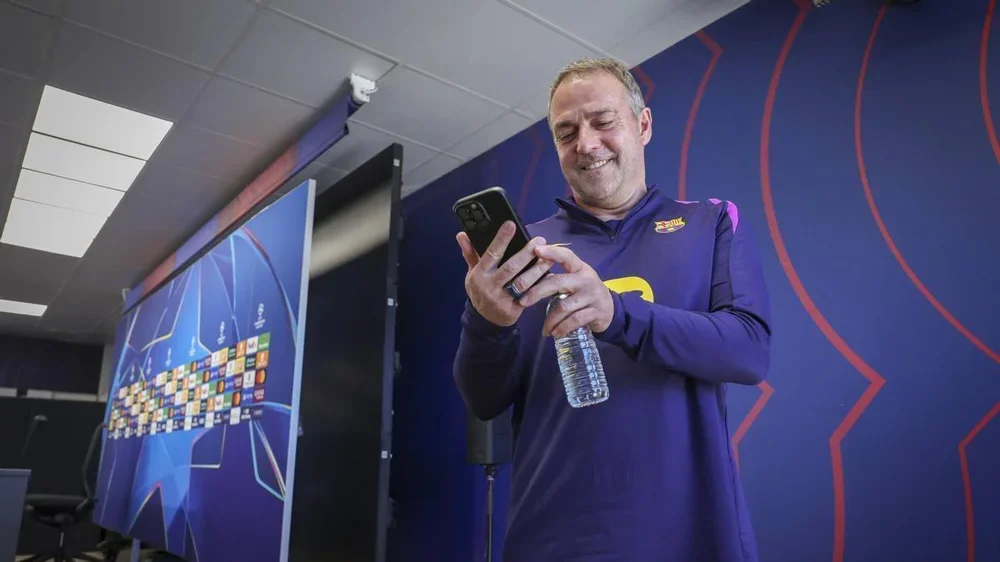
Hansi Flick admitted on April 21 that he still has two major dreams to fulfill at Barcelona: winning the Champions League and being in the dugout when the Spotify Camp Nou is fully completed. For now, he has already secured two league titles and thrown Real Madrid into disarray. Since the German took charge, Madrid has gone through three different coaches—Ancelotti, Xabi Alonso, and a now virtually doomed Arbeloa. Beyond the trophies, Flick has turned Barcelona into one of the most entertaining teams to watch, reconnected the club’s identity with its fans, and left Madrid searching for answers.
Xabi Alonso—once seen as Madrid’s long-term project—is already a thing of the past, while Barcelona celebrate their second consecutive league crown. The Blaugrana have achieved the toughest feat in football: winning after winning. To do so, they needed a more hands-on Flick compared to his debut season.
Back on September 1, Flick saw something he didn’t like and left a memorable line: “Last season we played and worked as a team, and the most important thing is that there are no egos, because egos kill team success.” A 1-1 draw at Vallecas frustrated him, but it wasn’t the result itself that worried him—it was the fear that the collective spirit his Barcelona had shown the previous year was fading.
**Searching for Leaders**
His words captured widespread attention, but they weren’t his only strong message of the season. On February 21, amid a run of poor results, he called for greater leadership: “Everyone is convinced of what we are doing. These are not easy moments, but communication is vital. We have been honest and open. I ask them questions—that’s how I work and manage. It’s important because we need leaders. You always have to communicate on the same level; then I’ll make decisions. I want the players to take responsibility, and they are doing it.” He repeated that theme after the team’s Champions League elimination at the hands of Atlético. “It’s not just about talking and saying two meters to the right or two to the left,” he explained vividly, “it’s about talking more, about having mature players who can show the way on the pitch.” That day, Flick pointed to Iñigo Martínez as an example—a leader the squad had missed the most this season.
**Two Big Winning Runs**
Barcelona built this league title around two major stretches of victories. The first came between matchdays 11 and 19, with nine straight wins, from a 3-1 victory over Elche to a 0-2 triumph at Espanyol. The second run occurred between matchdays 25 and 35, from a 3-0 win over Levante to a 2-0 victory in El Clásico. That Clásico win sealed their best streak of the campaign: eleven consecutive triumphs.
The contrast with Real Madrid also explains the evolution of the championship. On October 26, 2025, after losing 2-1 to Madrid in the reverse Clásico (matchday 10), Barcelona found themselves five points behind the white team—their biggest deficit of the season. But the momentum flipped as the weeks passed, and by April 25, 2026, they had opened up an eleven-point lead after a 0-2 win at Getafe combined with Madrid’s 1-1 draw at Betis, with 33 games played. That gap has now grown to 14 points following the Clásico at Spotify Camp Nou.
**Decisive in Both Boxes**
Barcelona’s title cannot be understood without their efficiency in the penalty areas. In goal, the signing of Joan Garcia has brought solidity: just 20 goals conceded in 29 matches (an average of 0.68 per game) and 15 clean sheets—numbers that reflect consistency and reliability. The former Espanyol goalkeeper has been a game-changer. Joan has shown reflexes he already displayed last season, but his ability to anticipate dangerous situations has stood out even more. His presence has been commanding in one-on-one situations and in coming off his line.